I've been reading a few other chemistry blogs around the web.
The Sceptical Chymist
This blog is from the editors of Nature. They have several different authors and many chemstry topics. Somehow they know about In the pipeline and Tenderblog. Powered by Moveable Type.
TotallySynthetic.com
This blog must be from some grad student trying to keep up on "the literature." I do enjoy the review natural product molecules in current literature I can't read about due to enormous subscription fees.
The Endless Frontier
Ph.D student at Harvard.
Interfacial Science
California post-doc.
post doc ergo propter doc
Canadian post-doc.
Check them out and enjoy.
In the blogosphere_
Sunday, May 21, 2006

Tuesday, May 16, 2006
Busy as Hell
Sometimes you're waiting around for the chemistry to happen, but I haven't been. It goes like this, I run the mass spec everyday which includes first, turning it on. Sometimes the plasma flickers, arcs, and starts melting the torch. This pisses me off, and it pisses my boss off because they are over $300 bucks. I still use them if they didn't melt all the way through.
Then, I move on to "optimizing" the "signal." This consists of aspirating a "tuning" solution and looking at a real time graph of "intensity" vs. time. And basically, you just move some voltages around to create high intensity of what you want, while creating low intensity for things you don't want.
Getting mid-way throught the morning now, I need to find some time to review the run from last night and prepare all the data in a type of lab report. The best time to start this is right after I start the calibration. I usually see some drift during the first calibration, so I restart it right about lunch time, so the lab keeps working while I'm off the clock.
Getting back from lunch, I have to quickly check the calibration and find some samples to run because there is no point in even thinking of running any samples until I know the instrument is going to work right. So I type in a sample sequence, make sure the QC is kosher, and then start making dilutions for pretty much everything but freshwater samples.
Now it's about 4pm and I have to finish reviewing yesterdays data, make any solutions that need to be made, and deal with email. Then I just schedule the MS to shutdown when it's done, which is usually between midnight and 3 in the morning.
Then, I move on to "optimizing" the "signal." This consists of aspirating a "tuning" solution and looking at a real time graph of "intensity" vs. time. And basically, you just move some voltages around to create high intensity of what you want, while creating low intensity for things you don't want.
Getting mid-way throught the morning now, I need to find some time to review the run from last night and prepare all the data in a type of lab report. The best time to start this is right after I start the calibration. I usually see some drift during the first calibration, so I restart it right about lunch time, so the lab keeps working while I'm off the clock.
Getting back from lunch, I have to quickly check the calibration and find some samples to run because there is no point in even thinking of running any samples until I know the instrument is going to work right. So I type in a sample sequence, make sure the QC is kosher, and then start making dilutions for pretty much everything but freshwater samples.
Now it's about 4pm and I have to finish reviewing yesterdays data, make any solutions that need to be made, and deal with email. Then I just schedule the MS to shutdown when it's done, which is usually between midnight and 3 in the morning.
Sunday, May 14, 2006
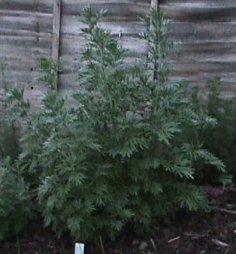
In my backyard
Thursday, May 11, 2006
Copper in seawater

This is the worst analysis ever, it's called Time Transient Resolved Analysis (TTRA) or Flow Injection Analysis of Seawater (FIAS). The methods are the same, they remove the salt from the seawater so I can measure the concentration of copper. The problem is the flow, there are two pumps, two valves, four lines, a 5mL loop, column, and six way valve, and the flow has got to be steady. A simple calculation reveals 7 to the 10th ways for it to screw up.
I have to use a bunch of para-film to keep the tube joints together because the pump builds up so much pressure in the peri pump tube to push everything throught the column.
The sample flows through a tube, mixes with a buffer (the whole shabang is pH sensitive), and flows onto the column. The metals, including copper and sodium, stick to the resin in the column. The column is rinsed with water, supposedly, the sodium washes off. Then the column is rinsed with diluted nitric acid and the copper comes off and goes into the spectrometer. The metals binding strength to the iminodiacetate resin in the column depends on pH.
Wednesday, May 03, 2006
Mass Spec at home?
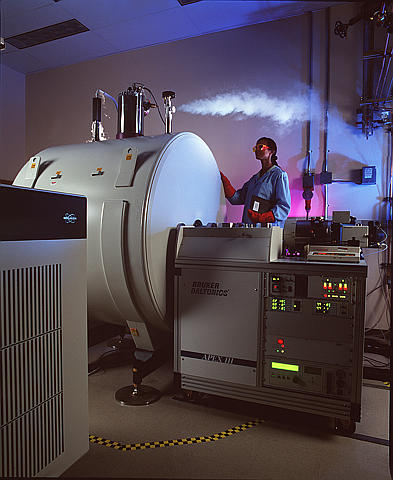
There is a reason why you can't have a mass spec at your house. It's not because it's so big, it's because they cost so much to fix. I had a service technician come out the other day and his visit to fix one part for one day was a cool $25,000. Ya, thats just to fix it. You could buy a pretty nice house for what they can cost new.
Parts break all the time, and you can't just keep running it like a car, a mass spec has to be fully optimized at all times to work properly. The technology is always pushed to the furthest point. If old designers of mass specs stuck with the original design and just improved on it, like a clothes washer, maybe they could last 30 years. But, then it would have run off of DOS.
The picture is not me or the mass spec I run, that thing is huge. And whats with all the multi-colored lights.
Monday, May 01, 2006
Ophiobolin C
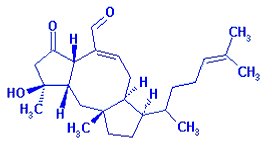
I worked on the synthesis of this molecule while in school at FSU as an undergraduate. It was one of my better academic experiences in Tallahassee. I had my own lab bench, my own glassware, and my own chemicals. I guess it was a taste of graduate school without the 80 hours a week. I met a lot of great people in there; post docs and graduate students who have all dispersed across the world from England to China. When I retire, I'm going to build a
laboratory and make natural products.
Wednesday, April 26, 2006
Plasma goes out
So I'm just calibrating the mass spec after getting it nicely optimized and out of nowhere, the plasma goes out. That basically means I have to start all over again. I could not find a reason for it to go out. The software that runs the instrument just gave this generic error that it displays anytime anything goes wrong. The software has more bugs than Windows 98.
It's not just pushing buttons all day folks, these things happen all the time. At least half my job is troubleshooting. Finding out why the mass spec is doing what it is doing. So, like a computer, I turned it off and then back on, and everything was fine.
It's not just pushing buttons all day folks, these things happen all the time. At least half my job is troubleshooting. Finding out why the mass spec is doing what it is doing. So, like a computer, I turned it off and then back on, and everything was fine.
Monday, April 24, 2006
DARTs and MS
I'm sure all the mass spec people have heard about this before because it is so cool and also one year old news. It's a new ionization method called DART (direct analysis in real time) invented by Robert B. Cody of JEOL USA and James A. Laramee of EAI Corp. It is a sample introduction system that can be coupled to a mass spectrometer, currently only coupled to a MS by JEOL.
The major difference here, compared to other mass specs, is the sample inlet is at atmospheric pressure. You can hold an object, such as an orange, up in front of the sample cone and get a reading of masses detected and find fungicides.
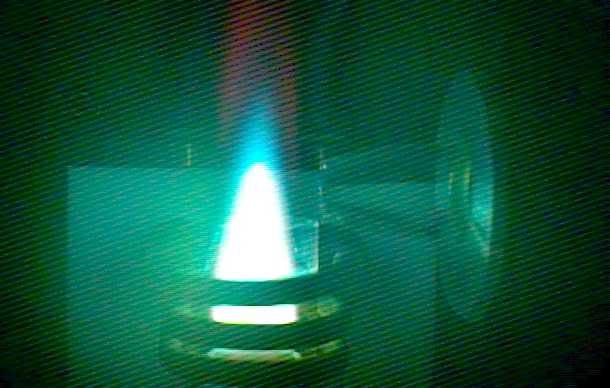
This technique works by applying an electrical potential to a gas (N2 or H2) to form a plasma that interacts with the sample and the atmosphere.
It took me a minute to picture the instrument layout in my head, I couldn't, so I went to the website. The path of the ion: First, gas is fed in, a plasma is formed, then the instrument opens up to the atmosphere. So, the open region is between the plasma torch and the sample cone. Then, the rest of the mass spec, the one they use happens to be a time-of-flight.
The major difference here, compared to other mass specs, is the sample inlet is at atmospheric pressure. You can hold an object, such as an orange, up in front of the sample cone and get a reading of masses detected and find fungicides.
This technique works by applying an electrical potential to a gas (N2 or H2) to form a plasma that interacts with the sample and the atmosphere.
It took me a minute to picture the instrument layout in my head, I couldn't, so I went to the website. The path of the ion: First, gas is fed in, a plasma is formed, then the instrument opens up to the atmosphere. So, the open region is between the plasma torch and the sample cone. Then, the rest of the mass spec, the one they use happens to be a time-of-flight.
Friday, April 21, 2006
MS at PittCon
Well, I didn't get to go to PittCon, even though it was only a 4 or 5 hour drive from here. And it looks like I missed out on a lot of cool analytical instrumentation as well as possible job leads.
My favorite company Thermo (read with sarcastic tone) introduced a new type of mass spec. In fact, they claim it is "the first totally new mass analyzer to be introduced to the market in more than 20 years." It is called the LTQ Orbitrap mass spectrometer. To read about its initial research, Anal. Chem. 2000, 72, 1156.
Apparently, the orbitrap takes the place of the quadrupole to separate the ions based on m/z. The orbitrap "has ions spinning around a carefully shaped central electrode while shuttling back and forth over its long axis in harmonic motion at frequencies dependent only on their mass-to-charge ratios," says R. Graham Cooks of Purdue University.
More interesting news from PittCon to come.
My favorite company Thermo (read with sarcastic tone) introduced a new type of mass spec. In fact, they claim it is "the first totally new mass analyzer to be introduced to the market in more than 20 years." It is called the LTQ Orbitrap mass spectrometer. To read about its initial research, Anal. Chem. 2000, 72, 1156.
Apparently, the orbitrap takes the place of the quadrupole to separate the ions based on m/z. The orbitrap "has ions spinning around a carefully shaped central electrode while shuttling back and forth over its long axis in harmonic motion at frequencies dependent only on their mass-to-charge ratios," says R. Graham Cooks of Purdue University.
More interesting news from PittCon to come.
Sunday, April 16, 2006
Bismuth
Interesting facts about Bi, mass 209 (the only stable isotope), atomic number 83.
It melts at 520 F, maybe possible in the oven.
It boils at 1833 K (2840 F). The ICP plasma I use is 8,000 - 10,000 K.
Not quite as toxic as other elements in the same group, arsenic and antimony. Bismuth is used in cosmetics. And it's in Pepto-Bismol
The most diamagnetic metal, a weak type of magnatism compared to ferro- or paramagnatism. It wouldn't stick to your fridge.
It is used as an internal standard, it is run through the mass spec with every sample at the same concentration, and I make sure the instrument gives the same result. One way to tell if the instrument drifts.
Around $8 / kg.
It melts at 520 F, maybe possible in the oven.
It boils at 1833 K (2840 F). The ICP plasma I use is 8,000 - 10,000 K.
Not quite as toxic as other elements in the same group, arsenic and antimony. Bismuth is used in cosmetics. And it's in Pepto-Bismol
The most diamagnetic metal, a weak type of magnatism compared to ferro- or paramagnatism. It wouldn't stick to your fridge.
It is used as an internal standard, it is run through the mass spec with every sample at the same concentration, and I make sure the instrument gives the same result. One way to tell if the instrument drifts.
Around $8 / kg.
Tuesday, April 11, 2006
Water droplet
I may have found the answer to my question of why that one drop of liquid always jumps up at me (see previous post), at physicsweb.org/articles/news/10/4/4/1
If I knew how to put the link in, I would.
If I knew how to put the link in, I would.
Blogroll
I finally found out how to write some code and put some more crap on the sidebar over there. It is now cool to put pictures on your blog, relevent to what you're talking about. And if you want to be really cool, you can put clever little captions on the picture for some comic relief.
But seriously, Dylan's blog about synthetic organic grad school life is great. I can now live my dream vicariously through his daily posts. I've been reading In the pipeline written by Derek Lowe for a while now, it's about life as a wonder drug maker in the pharmaceutical industry.
I also found out how to make your blog come into the top ten on Google. Actually, I read about it on some other dude's blog and I forgot his name. I've noticed people are as serious about getting referenced on the internet as in chemistry journals. To get your blog to the top ten, write about something specific, then email all the top read bloggers in that subject and kindly ask them to link your blog. Once you get enough links and enough people coming by, you are one of the first links for that specific subject on a google search. Or maybe that was the way to get more visitors to your blog?
Anyways, pictures are coming, and if I'm in a good mood, clever captions.
But seriously, Dylan's blog about synthetic organic grad school life is great. I can now live my dream vicariously through his daily posts. I've been reading In the pipeline written by Derek Lowe for a while now, it's about life as a wonder drug maker in the pharmaceutical industry.
I also found out how to make your blog come into the top ten on Google. Actually, I read about it on some other dude's blog and I forgot his name. I've noticed people are as serious about getting referenced on the internet as in chemistry journals. To get your blog to the top ten, write about something specific, then email all the top read bloggers in that subject and kindly ask them to link your blog. Once you get enough links and enough people coming by, you are one of the first links for that specific subject on a google search. Or maybe that was the way to get more visitors to your blog?
Anyways, pictures are coming, and if I'm in a good mood, clever captions.
Tuesday, April 04, 2006
Outsourcing
It is here. We are losing oppurtunities everyday. I'll make a future prediction: India and China will produce most of the new drugs simply because they have a lot more people actually doing research. They have four times as many people as we do, producing more scientist and engineers than we do. That's if their governments don't tear the country down.
It's fairly obvious to me why Americans don't want to go into science. It does not pay well. I read somewhere, adjusted for IQ, scientists are the lowest paid workers in the country. Especially for PhD's, they go to school for 4 to 6 years, then struggle to get a job. Even better of a question, why are we telling American college students to go into science when there are no jobs to get when you get out? Getting an academic research professor job for a chemist is like getting to the Major League in baseball. Only the elite can make it, it takes natural talent. So please, current professors out there, tell your students the truth: If they don't have a 4.0 and work for a "famous" scientist, they won't get their dream job doing whatever research interests them. If you're smart and you have the ability to go past a bachelors degree, the law or medical degree will earn you money after you have no problem finding a job. I wonder what the unemployment rate would look like between chemistry PhD's, lawyers, and doctors. I guess it would look better if you only looked at people working in the field of their degree.
By the way, I'm a happy scientist.
It's fairly obvious to me why Americans don't want to go into science. It does not pay well. I read somewhere, adjusted for IQ, scientists are the lowest paid workers in the country. Especially for PhD's, they go to school for 4 to 6 years, then struggle to get a job. Even better of a question, why are we telling American college students to go into science when there are no jobs to get when you get out? Getting an academic research professor job for a chemist is like getting to the Major League in baseball. Only the elite can make it, it takes natural talent. So please, current professors out there, tell your students the truth: If they don't have a 4.0 and work for a "famous" scientist, they won't get their dream job doing whatever research interests them. If you're smart and you have the ability to go past a bachelors degree, the law or medical degree will earn you money after you have no problem finding a job. I wonder what the unemployment rate would look like between chemistry PhD's, lawyers, and doctors. I guess it would look better if you only looked at people working in the field of their degree.
By the way, I'm a happy scientist.
Tuesday, March 21, 2006
March Update
Hopefully I'll be able to blog more than once a month. I started out thinking I could post everyday, like there would be plenty to talk about. Well, there is plenty going on, it's just a matter of remembering events and getting to a computer and thinking of a clever way to present things.
Anyways, the arsenic situation: Dumb mistake. It's too embarrasing to tell here where the false positives were coming from. Email me if you fall into a similar situation.
Anybody else hate when you pour a liquid out of a container into another container containing liquid with a wide mouth, like a bucket and the first drop hits and there's always that one drop that jumps out. Whats the deal with that? Is it the liquid that was being poured in or is it the liquid that is already sitting in the container that you poured into? Confusing? Yes.
Also, I'm going to create a blogroll on the sidebar over there to list cool scientific blogs like Derek Lowe's on Corante and Dylan something's that talks about synthetic organic grad school.
Anyways, the arsenic situation: Dumb mistake. It's too embarrasing to tell here where the false positives were coming from. Email me if you fall into a similar situation.
Anybody else hate when you pour a liquid out of a container into another container containing liquid with a wide mouth, like a bucket and the first drop hits and there's always that one drop that jumps out. Whats the deal with that? Is it the liquid that was being poured in or is it the liquid that is already sitting in the container that you poured into? Confusing? Yes.
Also, I'm going to create a blogroll on the sidebar over there to list cool scientific blogs like Derek Lowe's on Corante and Dylan something's that talks about synthetic organic grad school.
Tuesday, February 28, 2006
Phosphorus and methamphetamine
A great idea, all this time, and no comments. Well, fellow mass spectrometrists of the world, I've got some new things to talk (write, type, blog) about.
Short side note, anyone ever hear a hissing noise comming from the torch box. It's not an electrical arc or I just can't see one. I have produced an electrical arc on the torch itself before and gave it a nice melted dimple. This noise seems to be something else, almost sounds like gas or water blowing out a small hose, but I think if that was the case, things wouldn't be working as well as they have been. No visible damage or drift caused by noise.
Next up, I just got word that I will be analyzing some samples from a meth lab bust. I'll be looking for phosphorus. I imagine I'll find some since the samples are taken from powder made by grinding up match heads. So, I don't think I'll have any actual meth in the lab, sorry. I know detection limits are crappy, like 1ppm, anyone know about any interferences or any other problems analyzing phosphorus.
Methamphetamine has quite a history. It's a farely new drug, first synthesized in 1919 in Japan. It was distributed during WWII to Nazi soldiers as a stimulant. In the 50's it saw such uses as a cure for narcolepsy, post-encephalitic parkinsonism, alcoholism, depression, and obesity. What a wonder drug back then. Made illegal sometime in the 80's when its recreational use started up.
Easily made by even non-chemists from pseudoephedrine hydrochloride, various different procedures found in chemistry journals or sketchy websites. There is a wealth of information found on Wikipedia (who checks the facts on this website?)
Short side note, anyone ever hear a hissing noise comming from the torch box. It's not an electrical arc or I just can't see one. I have produced an electrical arc on the torch itself before and gave it a nice melted dimple. This noise seems to be something else, almost sounds like gas or water blowing out a small hose, but I think if that was the case, things wouldn't be working as well as they have been. No visible damage or drift caused by noise.
Next up, I just got word that I will be analyzing some samples from a meth lab bust. I'll be looking for phosphorus. I imagine I'll find some since the samples are taken from powder made by grinding up match heads. So, I don't think I'll have any actual meth in the lab, sorry. I know detection limits are crappy, like 1ppm, anyone know about any interferences or any other problems analyzing phosphorus.
Methamphetamine has quite a history. It's a farely new drug, first synthesized in 1919 in Japan. It was distributed during WWII to Nazi soldiers as a stimulant. In the 50's it saw such uses as a cure for narcolepsy, post-encephalitic parkinsonism, alcoholism, depression, and obesity. What a wonder drug back then. Made illegal sometime in the 80's when its recreational use started up.
Easily made by even non-chemists from pseudoephedrine hydrochloride, various different procedures found in chemistry journals or sketchy websites. There is a wealth of information found on Wikipedia (who checks the facts on this website?)
Saturday, February 18, 2006
Message board
My original idea was to create a message board where mass spec researchers and analysts could discuss trouble shooting. I suggested it to the company which makes the mass spec I work with, but I havn't recieved any reply and didn't really expect it.
So, I'm taking it upon myself. I am currently an environmental chemist using mass spectrometry to analyze water and sediment samples for metals. The mass spec I use uses a quadrupole to filter the ions and it also has a type of collision cell that all the companies are putting out now. The collision cell is supposed to reduce interferents by colliding the interferents with other gas molecules supplied into the collision cell. It also has kinetic energy discrimination which uses some various lens voltages within the collision cell to limit the range of kinetic energies in the ion beam coming out of the collision cell.
I've got everything working pretty well after battling for 6 to 8 months. But I still have some elusive problems which is why I'm creating this blog, or message board.
Anybody analyze Arsenic in salt water with a collision cell? I can't get rid of some interferent at mass 75 which gives me a constant result of 6 - 10ppb in salt water samples that are confirmed having less arsenic by a optical method (ICP emission.) I can discuss a lot more if anybody else knows anything about this.
So, I'm taking it upon myself. I am currently an environmental chemist using mass spectrometry to analyze water and sediment samples for metals. The mass spec I use uses a quadrupole to filter the ions and it also has a type of collision cell that all the companies are putting out now. The collision cell is supposed to reduce interferents by colliding the interferents with other gas molecules supplied into the collision cell. It also has kinetic energy discrimination which uses some various lens voltages within the collision cell to limit the range of kinetic energies in the ion beam coming out of the collision cell.
I've got everything working pretty well after battling for 6 to 8 months. But I still have some elusive problems which is why I'm creating this blog, or message board.
Anybody analyze Arsenic in salt water with a collision cell? I can't get rid of some interferent at mass 75 which gives me a constant result of 6 - 10ppb in salt water samples that are confirmed having less arsenic by a optical method (ICP emission.) I can discuss a lot more if anybody else knows anything about this.
Subscribe to:
Posts (Atom)